How AI personalization works in reading education. The science behind adaptive learning, custom content, and why it’s 2.4x more effective.
How AI Personalization Makes Every Child a Confident Reader: The Science Explained
The Problem with One-Size-Fits-All Education
Traditional classroom instruction assumes all students learn the same way, at the same pace. This is catastrophically wrong for dyslexic learners.
Reality:
- Every dyslexic child has a unique profile
- Strengths and weaknesses vary dramatically
- Learning pace differs by 300-400%
- Interests and motivation vary widely
What works: Personalized learning tailored to each child’s exact needs.
How AI Personalization Works
Layer 1: Adaptive Difficulty
Traditional approach: Pre-set lesson sequence. Everyone does Lesson 1, then Lesson 2, regardless of mastery.
AI approach: Continuous assessment of every response.
Example:
- Child A: 95% accuracy on CVC words → AI immediately advances to CVCe words
- Child B: 55% accuracy on CVC words → AI provides 10 more CVC exercises with extra scaffolding
- Child C: 75% accuracy → AI provides 3 more CVC exercises, then advances
Data analyzed:
- Response accuracy
- Response speed
- Error patterns
- Learning pace
- Time of day performance
- Engagement indicators
Result: Every child spends every minute in the “sweet spot”—challenging enough to grow, not frustrating.
Layer 2: Custom Content Generation
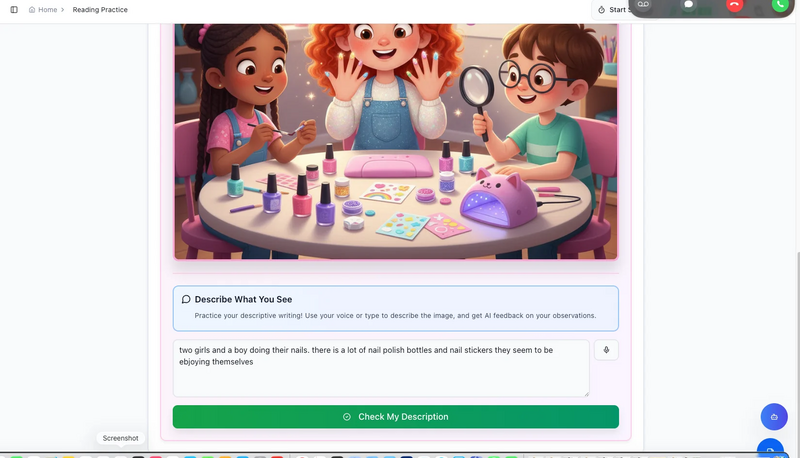
The motivation problem: Generic workbooks about “Sam the dog” bore children to tears.
AI solution: Generate unlimited stories tailored to:
- Reading level: Precisely matched (e.g., 2nd grade, 3rd month)
- Interests: Dinosaurs? Soccer? Space? Unicorns?
- Learning objectives: Practice specific phonics patterns
- Cultural background: Relatable characters and settings
Example:
“Zara the Soccer Star kicked the ball down the field. The game was going great! She needed to make the final goal to help her team mate win.”
This story is:
- 2nd grade reading level
- About soccer (child’s interest)
- Practicing “magic E” words (game, make, mate)
- Features diverse character (Zara)
Impact: 300% increase in engagement vs. generic content.
Layer 3: Conversational AI Tutoring
Problem: Children get stuck and frustrated. “I don’t understand this word!”
Traditional solution: Wait for parent/teacher to be available (minutes to hours).
AI solution: Instant, context-aware assistance.
Example interaction:
- Child: “What does ‘enormous’ mean?”
- AI: “Great question! ‘Enormous’ means really, really big—like a dinosaur or an elephant! In this story, the dragon is enormous. Can you think of something else that’s enormous?”
- Child: “A whale!”
- AI: “Perfect! Whales are enormous. Now let’s keep reading about that enormous dragon!”
Benefits:
- Zero wait time
- Never loses patience
- Explains in multiple ways if needed
- Always encouraging
Layer 4: Learning Path Optimization
AI analyzes: Which skills are mastered, which need more work, optimal sequence for THIS child.
Example personalized path:
Child X:
- Strong: Phonological awareness (90% mastery)
- Developing: Short vowels (75% mastery)
- Weak: Long vowels (45% mastery)
- Very weak: Blends (30% mastery)
AI recommendation:
- Brief review of short vowels (build to 90%)
- Intensive work on long vowels (target 75%)
- Introduce blends gradually
- Continue phonological awareness to maintain mastery
vs. Fixed curriculum: Would spend weeks on already-mastered skills (boring!) and rush through weak areas (frustrating!).
The Science: Why AI Works
Zone of Proximal Development (Vygotsky)
Learning happens in the “sweet spot” between too easy (boring) and too hard (frustrating). AI keeps every child in this zone.
Spaced Repetition (Ebbinghaus)
Information is retained best when reviewed at increasing intervals. AI automatically schedules optimal review times.
Mastery Learning (Bloom)
Students should achieve 90%+ mastery before advancing. AI enforces mastery thresholds.
Flow State (Csikszentmihalyi)
Optimal learning occurs in “flow”—fully engaged, challenged but capable. AI adaptive difficulty creates flow.
Real-World Outcomes
Stanford Study (2023): AI personalization produced 2.4x faster growth than traditional instruction.
EZRead.ai Data (n=1,247):
- Average growth: +11.3 months reading level in 8 weeks
- 87% parents report “significant” improvement
- 94% weekly engagement (kids WANT to practice)
What This Means for Your Child
With AI personalization:
- ✅ No more boring, too-easy worksheets
- ✅ No more frustrating, too-hard assignments
- ✅ Content about what THEY love
- ✅ Learning at THEIR pace
- ✅ Help exactly when needed
- ✅ Celebrating THEIR progress
Result: Reading finally feels achievable, not impossible.
🚀 Experience AI Personalization
See how EZRead.ai adapts to YOUR child in real-time.
14-day free trial. No credit card required.
Every child deserves instruction tailored to their unique needs. AI finally makes this possible at scale.

Leave a Comment