The wrapping paper is flying, siblings are squealing, and your child with autism or ADHD is on the verge of a meltdown because someone else opened a present first.
If this scene sounds familiar, you’re not alone.
Holiday gift-giving can be overwhelming for children with special needs. The excitement, the waiting, the unpredictability of what’s inside each box, the pressure to react “appropriately”—it’s a sensory and emotional minefield.
That’s why we created “Christmas Morning: Opening Gifts Nicely,” a beginner-level social story designed to help children navigate one of the most emotionally charged moments of the year.
Why Gift-Opening Is So Hard for Some Kids
For neurotypical children, the social script of gift-giving comes naturally. They intuitively understand to wait their turn, say thank you, and smile even when they get socks instead of the toy they wanted.
But for children with autism, ADHD, or other special needs, these unwritten rules aren’t obvious. They’re grappling with:
Impulse control – Waiting when there are presents right in front of them
Delayed gratification – Watching others open gifts when they want their turn NOW
Emotional regulation – Managing disappointment when a gift isn’t what they expected
Social reciprocity – Understanding that their reaction affects the gift-giver’s feelings
My daughter struggles with all of this. Last Christmas, she opened a gift from her grandmother, saw it wasn’t what she hoped for, and her face fell immediately. The hurt in my mother’s eyes was heartbreaking—and my daughter had no idea why everyone got quiet.
That’s the gap this social story bridges.
What Makes This Social Story Effective
1. It’s Written at a Beginner Reading Level
This story uses simple sentences and clear language that young children or those with reading challenges can understand. There’s no confusion about what’s expected—just straightforward guidance.
2. It Teaches the “Why” Behind Social Rules
The story doesn’t just say “say thank you.” It explains that “saying ‘thank you’ makes people feel happy, and I feel good when I am polite.”
Understanding the reason behind social expectations helps children internalize them rather than just performing them robotically.
3. It Prepares Kids for Disappointment
Here’s the game-changer: the story specifically addresses what to do “if I get a gift I don’t expect.” It validates that this can be surprising, then provides a concrete strategy—smile and say thank you anyway, because “the person who gave it to me wanted to make me happy.”
This pre-teaching is crucial. When the moment actually happens, your child has already mentally rehearsed the appropriate response.
4. It Emphasizes Family Connection
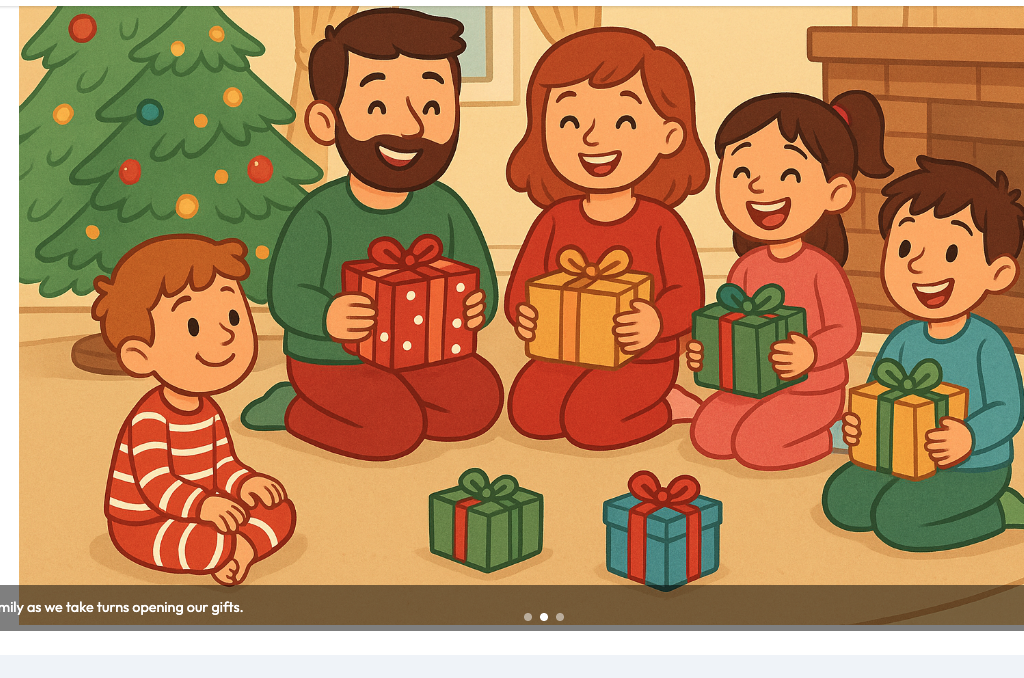
The story reframes waiting and watching others as a positive experience: “Watching others open their gifts is fun and helps me feel closer to my family.”
This shifts the focus from “I’m not getting what I want right now” to “I’m part of something special.”
How to Use This Story Before the Holidays
Don’t wait until Christmas morning to introduce this. Here’s my recommended approach:
Starting in Early December:
Read the story together 2-3 times per week
Point out the illustrations showing the child waiting patiently and saying thank you
Practice the key phrases: “Thank you!” and “Can I watch you open your gift?”
One Week Before Christmas:
Increase reading to daily
Do role-play sessions where you give your child wrapped boxes (empty or with small items)
Practice the scenario where they don’t like the gift—this is crucial!
Christmas Eve:
Read it one more time as a reminder
Talk through what will happen the next morning
Remind them of the key rules: wait your turn, say thank you, smile even if it’s a surprise
Christmas Morning:
Keep the book nearby as a reference
If they start to get overwhelmed, you can reference it: “Remember what we learned about waiting patiently?”
The Hidden Lesson: Gratitude Over Excitement
One of the most powerful aspects of this social story is that it gives children permission to not be wildly excited about every gift.
The common misconception (listed in the Social Cues Guide at the end) is that kids think “showing immediate excitement is always necessary.” This puts enormous pressure on children who struggle with spontaneous emotional expression.
Instead, this story teaches that gratitude and politeness matter more than performative enthusiasm. You can smile and say thank you without jumping up and down—and that’s perfectly acceptable.
This is a relief for many children with autism who find it exhausting to “perform” emotions they don’t feel.
Handling Real-World Imperfection
Even with preparation, Christmas morning probably won’t go perfectly. Your child might still:
Grab a present out of turn
Forget to say thank you
Look disappointed when they open something unexpected
That’s okay. This is a learning process.
When these moments happen:
Stay calm – Your reaction sets the tone
Gently redirect – “Remember, we say thank you”
Praise what they do right – “Great job waiting for your turn!”
Review the story afterward – “Let’s read our Christmas story again and talk about what happened”
Beyond Christmas: Building Lifelong Skills
The skills in this social story extend far beyond the holiday season. Turn-taking, expressing gratitude, managing disappointment, and thinking about how our reactions affect others—these are foundational social-emotional skills that children will use throughout their lives.
Birthdays, celebrations, receiving awards, even casual interactions where someone does something nice for them—all of these moments require the same core competencies.
By teaching these skills in the concrete, visual, repetitive format of a social story, you’re giving your child tools they’ll carry with them long after they stop believing in Santa.
The Bottom Line
Christmas should be joyful, not stressful. But for families with children who have special needs, the holidays often bring as much anxiety as excitement.
This social story won’t eliminate every challenge, but it will give your child a roadmap for navigating one of the season’s trickiest social situations. It provides language when words are hard to find, structure when everything feels chaotic, and reassurance that they can handle this.
Last Christmas was tough for us. This year, I’m starting earlier. We’re reading the story, we’re practicing, and we’re setting my daughter up for success instead of hoping she’ll figure it out on her own.
Because the goal isn’t perfect behavior—it’s giving our kids the tools to participate in family traditions with confidence and joy.
Christmas Social Story – Opening Gifts Politely for Autism and ADHD